
Memory
Memory is what an agent carries between conversations — facts about you, your preferences, how you like work done. It is stored deliberately and you can read every entry.
When to use it
Section titled “When to use it”Memory is for facts with a long shelf life that you should not have to repeat: which timezone you work in, who your team is, that you want numbers rounded, that “the report” means the one in a specific folder.
It is not a filing cabinet. Content belongs in an output; background for one body of work belongs in a project.
How an agent uses it
Section titled “How an agent uses it”The agent decides what is worth keeping and writes it down — often after you correct it, or state a preference. At the start of a conversation it loads an index of what it knows, and pulls in the entries relevant to the task rather than everything it has ever stored.
You can also just tell it: “remember that I never want Friday meetings” is a normal instruction and it will store it.
Inspecting and correcting
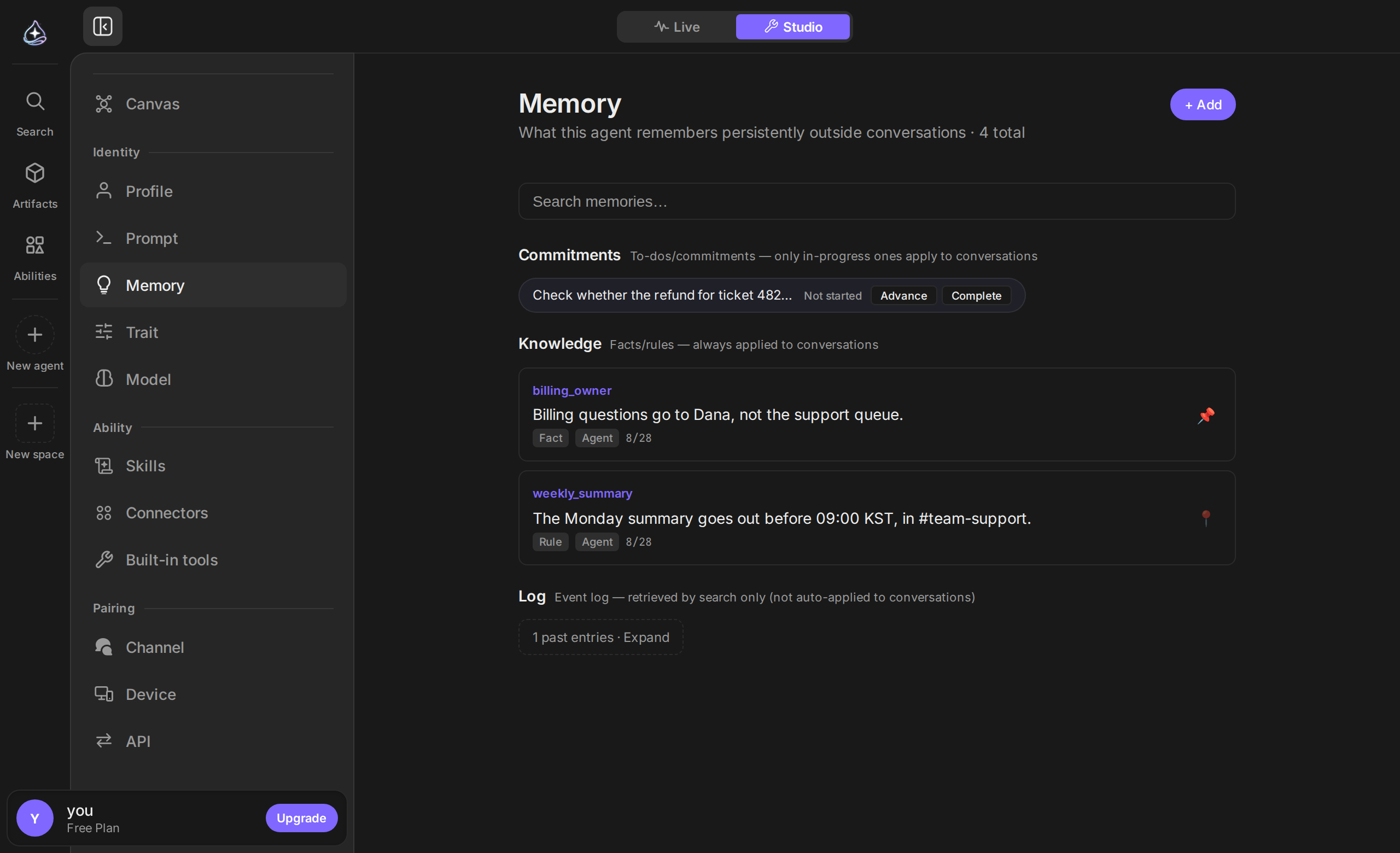
Section titled “Inspecting and correcting”Memory is listed in Agent Builder, under the agent’s Identity section. Every entry is readable, and you can delete anything that should not have been kept.
Do check it occasionally. Agents write down what they infer, and an inference stated as fact — “prefers short replies” after one impatient message — will quietly shape answers for weeks.
Archive
Section titled “Archive”With the Dream trait on, the agent tidies its memory while it is idle. Memories that are no longer useful, and memories merged into another one, are archived instead of deleted. An archived memory is not loaded into conversations, and the agent does not find it when it searches its memory.
Archived memories collect in the Archived group at the bottom of the memory list. The group is collapsed. Expand it to see, for each memory, the date it was archived, Restore, and delete. Restore puts the memory back into use from the next conversation. Delete the ones you will not need again.
A memory you ask the agent to forget during a conversation is deleted right away, not archived. Archiving only happens in Dream’s cleanup.
When Dream finishes a cleanup, it gives each memory a one-line summary and a few search terms.
- The summary goes into the memory index the agent loads at the start of a conversation. Without one, the index holds the start of the memory, cut short, so a long memory keeps its point when it has a summary.
- The agent matches the search terms along with the memory’s text when it searches. A memory that says “report” is found by a search for “write-up”.
Open a memory to see its Dream summary and search terms. You cannot edit them. When the memory’s content changes, the summary is marked out of date and the next Dream writes a new one. Until then, the memory index uses the start of the memory.
Memories of an agent without Dream have no summary or search terms.
Turning it off
Section titled “Turning it off”Memory is a built-in tool group. Switching it off for an agent stops it storing and recalling, and stops the memory index being loaded at the start of a conversation. Existing entries are kept; the agent stops using them.
This is the right setting for an agent that handles other people’s data, or one you want stateless and predictable.
Limits
Section titled “Limits”- Memory is per agent, not per account.
- The agent decides what to store; you cannot pre-write a list of memories, but you can tell it what to remember and delete what it got wrong.
- Deleting an entry stops it being recalled in future runs. It does not edit conversations where it was already used.
- Archived memories are not deleted on their own. When they pile up, delete them from the Archived group.
- Dream picks the search terms during cleanup. A wording that is in neither the search terms nor the text may not find the memory.
- Memory is not searchable content storage. Large documents belong in outputs.